Why one builder’s quote is cheaper — and how to tell if it really is
September 13, 2026
You have two quotes for the same house. One is substantially cheaper than the other. The plans are the same,…

September 7, 2026
You signed a fixed-price contract. Months later, invoices arrive carrying lines you do not recognise, and the number you agreed to has quietly become a different number.
Nothing was hidden from you. It was all in the contract — in the columns of allowances you skimmed past, because you were looking at the total at the bottom of the page, and the total looked good.
This is the most common way a fixed price stops being fixed. It is worth understanding properly before you sign anything, with any builder.
Most residential building contracts in New South Wales contain two kinds of allowance.
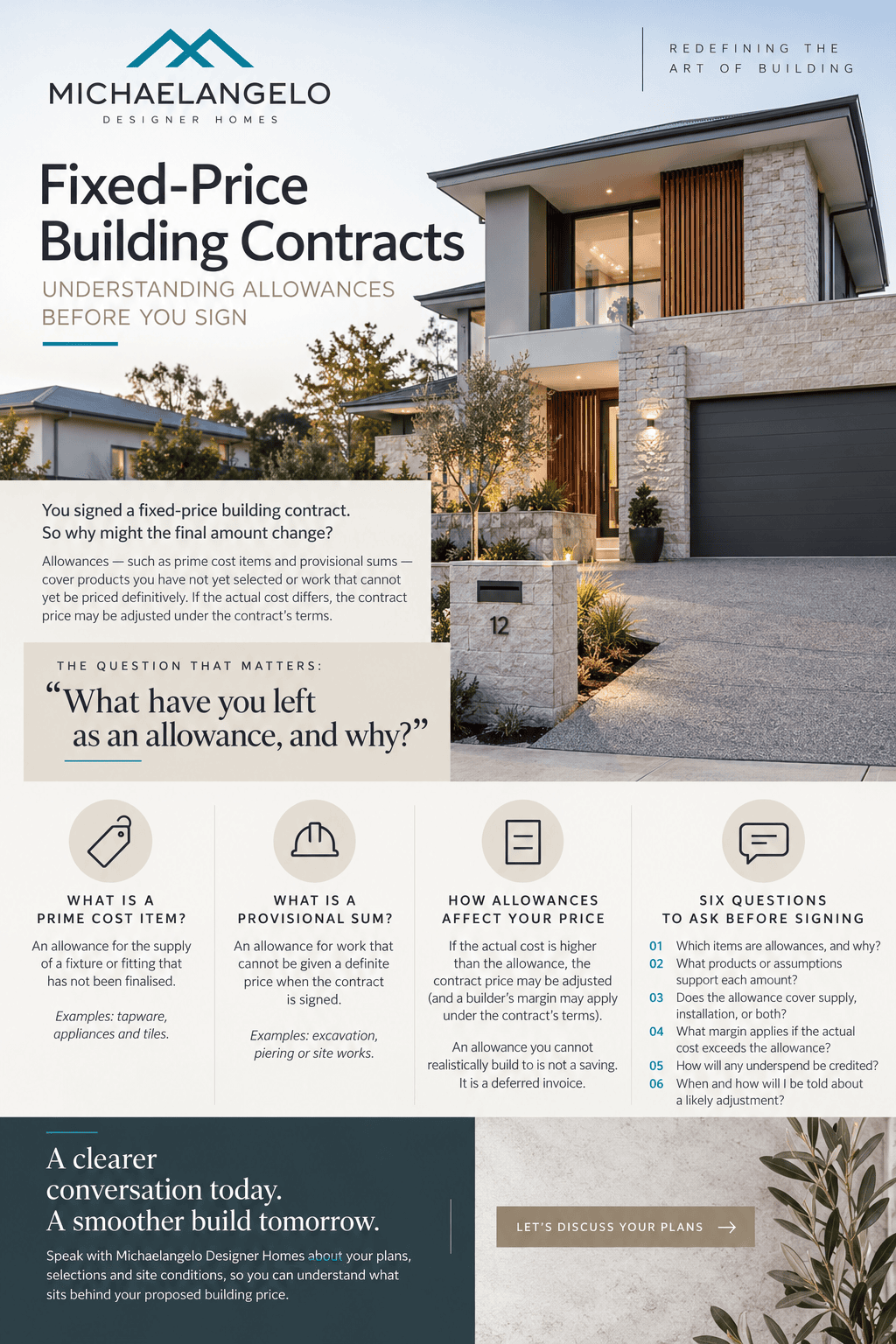
A prime cost item is a sum set aside for a product that has not been selected yet — tapware, tiles, an oven. The builder includes an estimated figure, and once you choose the actual product, the difference is settled.
A provisional sum is a figure for work that has not been fully defined yet — site works, drainage, piering. The builder estimates it, and when the real cost is known, the difference is settled.
Both are legitimate and both are normal. There are genuinely things that cannot be priced at contract stage, and a contract that pretended otherwise would not be more honest — it would be less.
The NSW Government’s guidance on contracts for residential building work explains how prime cost items are treated, and the Housing Industry Association publishes guidance on prime cost and provisional sums for New South Wales. Both are worth reading before you sign.
The problem is not that allowances exist. It is what happens when they are set too low.
Under the standard HIA New South Wales residential building contract, when the actual cost of a prime cost or provisional sum item exceeds the allowance, the builder may claim the excess — plus a margin on that excess, and must provide evidence of the cost. That margin is stated in the contract, usually in Schedule 1. Where that contract leaves it blank, it defaults to 20 per cent.
Consider what that means when two builders quote the same job.
One includes a tiling allowance of $12,000. The other includes $20,000 for the same scope. The first tender now looks $8,000 cheaper.
If the work genuinely costs $20,000, the difference does not disappear. It arrives later as a variation, with a margin applied on top.
That does not establish why the lower allowance was used. It does show why comparing the totals alone can be misleading, and why the allowances behind the total deserve as much attention as the number at the bottom of the page.
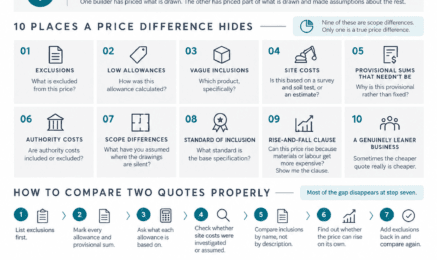
The allowances are one of ten places a price difference can hide. We have written separately about how to compare two builders’ quotes properly.
When people learn that part of a contract is provisional, they often conclude that none of it can be relied on. That is the wrong lesson, and it stops them asking the question that actually matters.
There are two genuinely different things going on, and they behave differently.
The first is your selections. Tiling, flooring, stone — the finishes where the figure cannot be settled until you have chosen. These carry an allowance only until you make the choice. Then they become fixed. Nothing about them is unknowable. They are simply not decided yet.
The second is genuinely provisional — work that cannot be known until the ground is opened or an authority rules, where no amount of estimating changes the position:
These are provisional not because nobody tried to price them, but because the scope or quantity is physically or legally unknowable at the time the contract is signed.
So the question to ask is not “is anything provisional?” It is “what have you left provisional, and why?” A builder who can answer that item by item is telling you something useful. A long list of vague allowances with no explanation is telling you something too.
Two details are worth confirming in writing, because they are a common source of surprise.
Supply, or supply and installation. Under the standard New South Wales arrangement, a prime cost allowance is for the supply of the item only. If the product you choose is heavier, larger or more complex to install than what was assumed, the installation cost can move even when the product price does not.
What happens if you spend less. If your selection comes in under the allowance, the contract should say plainly that the difference is credited back to you. Ask how, and at what point in the build it appears.
Ask the same six questions of every builder you are comparing. The answers will tell you more about the real cost of your home than the totals will.
And read the exclusions. What a contract leaves out matters as much as what it allows for. Landscaping, driveways, fencing, letterboxes, clotheslines, floor coverings and window furnishings are commonly excluded. None of that is improper — but if you have not read the exclusions, you have not read the price.
We price from actual trade quotations and from a Schedule of Rates maintained with our own suppliers and subcontractors, rather than from a generic dollars-per-square-metre industry figure.
Where a builder might offer a lean base price supported by a long list of allowances, we specify the actual product and fix the price before you sign. Our inclusions are named to specific products — a specific tapware model, a specific appliance, a specific fitting — priced to real supplier and trade rates. Fixtures, fittings, tapware, appliances, joinery and the standard trade packages are fixed to real quotations.
On the finishes that do carry an allowance until you select, we set that allowance at a realistic level for the standard actually specified, rather than at a figure that makes a tender look sharper than the build will be.
An allowance you cannot realistically build to is not a saving. It is a deferred invoice.
Before it becomes a problem, rather than after.
On selection allowances, once you have chosen, we price your actual selection and confirm it with you before it is locked in. If it sits above the allowance, you see that and approve it at the time.
On genuinely provisional items, we reconcile against the real cost the moment the fact arrives — the soil classification, the Sydney Water determination — and bring it to you for approval before the work proceeds.
The situation people describe, where they find out too late to do anything about it, happens when an allowance is allowed to run silently and appears at claim time. We front-load the unknowns into the design and investigation phase and raise every movement as it occurs, so decisions are made with the facts in front of you.
Piering is the clearest example, because it is the line most often left provisional and the hardest to check after the fact. Once the concrete is poured, nobody can see how deep a pier went.
So we don’t ask you to take our word for it. When the piers are bored, you are invited on site to measure them with us — before any concrete goes in. The depths are measured, recorded and signed.
That signed measure is what the allowance is reconciled against. If the founding conditions come in shallower than allowed, the difference is credited. If they come in deeper, you have stood over the hole and watched the figure being taken.
It takes an hour to organise and it removes the argument entirely. The number isn’t something we report to you afterwards. It’s something you were there for.
That is the difference worth looking for. Not a price that can never change — sometimes the ground decides otherwise — but knowing which lines can move, knowing why, and being told while you can still do something about it.
Michaelangelo Designer Homes builds custom homes and knockdown rebuilds across Greater Sydney, within our established service zones. If you would like to see how we price and run a build before committing to anything, our six-step process sets it out.
September 13, 2026
You have two quotes for the same house. One is substantially cheaper than the other. The plans are the same,