What a block will actually cost you to build on
September 18, 2026
Two blocks on the same street. Same size, same price. One is straightforward to build on. The other needs piered…

September 13, 2026
You have two quotes for the same house. One is substantially cheaper than the other. The plans are the same, the block is the same, the brief was the same.
So where did the difference go?
It is almost never one number. A large gap between two building quotes is usually a dozen quiet decisions about what to include, what to assume, and what to leave out — and every one of them is findable if you know where to look.
A note on sequence: if you are still deciding what to build — a project home, an established design adapted to your block, or a fully custom home — that decision comes before this one. We have written about how to tell which one actually suits you.
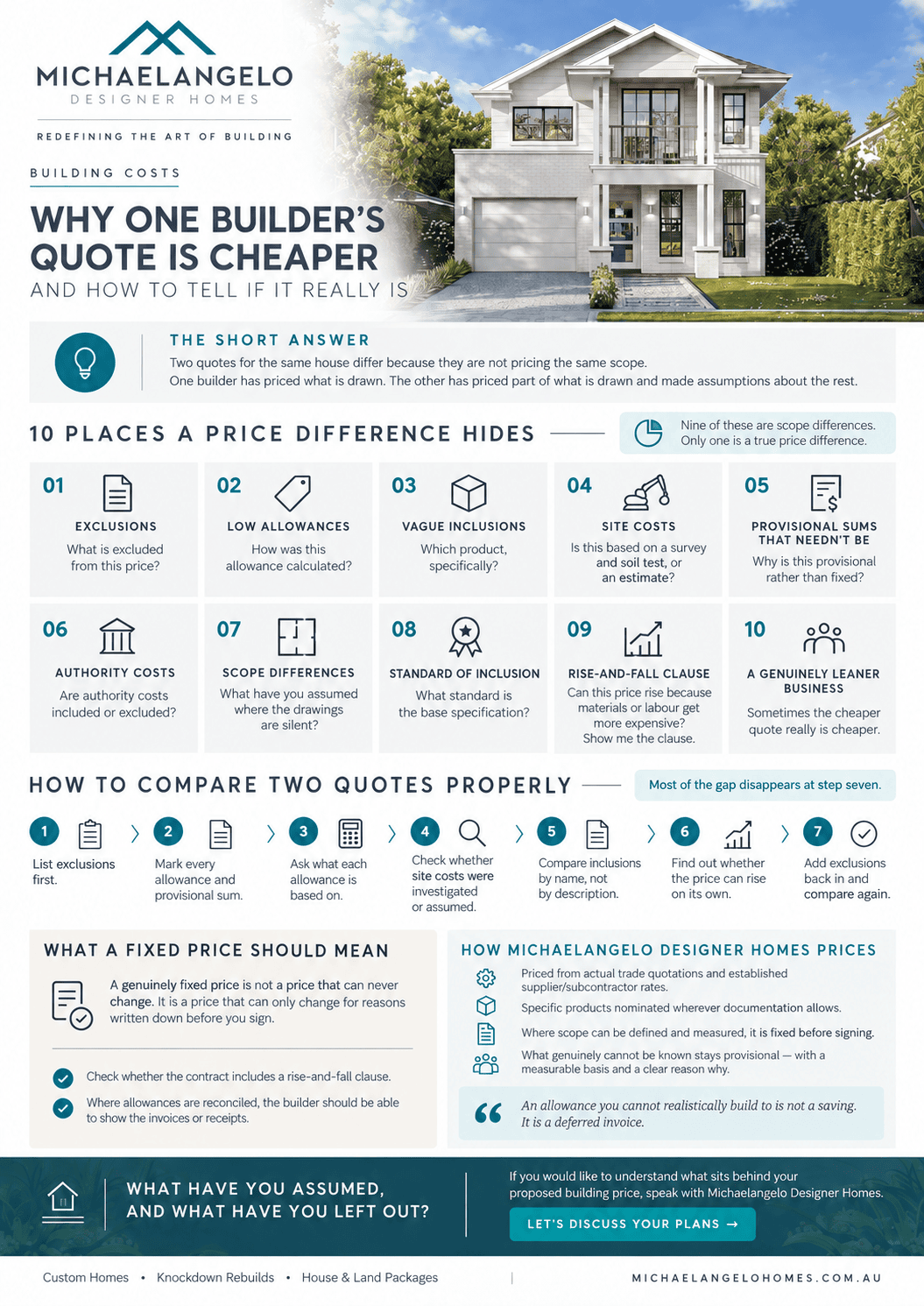
Two quotes for the same house differ because they are not pricing the same scope. One builder has priced what is drawn. The other has priced part of what is drawn and made assumptions about the rest.
Neither quote is necessarily wrong. But only one of them tells you what the house will cost.
The gap usually lives in ten places. Most people compare the totals and never look at any of them.
| Where it hides | What it looks like | What to ask |
|---|---|---|
| Exclusions | Work simply not in the price — landscaping, external works, window furnishings, pools, telecommunications and NBN activation | “What is excluded from this price?” |
| Low allowances | A realistic figure in one quote, an optimistic one in the other | “How was this allowance calculated?” |
| Vague inclusions | “Quality European appliances” versus a named model | “Which product, specifically?” |
| Site costs | A nominal figure carried before anyone has surveyed or tested the ground | “Is this based on a survey and soil test, or an estimate?” |
| Provisional sums that needn’t be | Whole categories left provisional when the scope is fully documented | “Why is this provisional rather than fixed?” |
| Authority costs | Council fees, bonds, Sydney Water requirements and service connections left out | “Are authority costs included or excluded?” |
| Scope differences | The two builders have read the same drawings differently | “What have you assumed where the drawings are silent?” |
| Standard of inclusion | The same room, built to two different specifications | “What standard is the base specification?” |
| A rise-and-fall clause | A clause letting the price rise with market cost movements after you sign — different from the normal prime cost and variation adjustments every fixed-price contract carries | “Can this price rise because materials or labour get more expensive? Show me the clause.” |
| A genuinely leaner business | Lower overheads, a different way of working | Nothing — this one is real |
Nine of those ten are differences in what has been priced. Only the last is a difference in price.
This needs saying plainly, because an article claiming every cheap quote is a trap is just an expensive builder’s sales pitch.
Builders run differently. Overheads differ. Buying power differs. A builder can be genuinely cheaper for the same work, and if the scope really is identical and the inclusions really are the same, the cheaper quote is the better deal.
The point is not that cheaper is suspicious. The point is that you cannot tell which kind of cheaper you are looking at until you compare scope rather than totals.
Because the total is the one number both builders control completely. Every assumption, exclusion and allowance behind it moves that figure, and none of those movements is visible from the front page.
Our post on fixed-price contracts and allowances works through one of these mechanisms in detail — what happens when an allowance is set low and the real cost arrives later.
That is one line item. There are nine others doing the same thing.
Do this before you compare a single dollar figure.
Most of the gap disappears at step seven. What remains is the genuine price difference — and now you are comparing builders instead of documents.
A genuinely fixed price is not a price that can never change. It is a price that can only change for reasons written down in front of you before you sign.
We build under the HIA New South Wales residential building contract. On the first page of its particulars, above where the owner signs, it lists every reason the price can move: planning and building approvals, a survey being required, a consultant reporting on site conditions, a tax or authority charge introduced after signing, a variation you have agreed to in writing, and the reconciliation of prime cost and provisional sum items.
That is the whole list. There is no clause allowing the price to rise because timber or steel became more expensive.
You do not have to take our word for any of this. The NSW Government publishes guidance on contracts for residential building work, and the Housing Industry Association publishes guidance for New South Wales on prime cost items and provisional sums. Both are worth reading before you sign anything, with any builder.
Two things in that contract are worth knowing about, whoever you build with.
You can walk away if the ground turns out to be bad enough. If extra work arising from hidden site conditions is estimated to exceed 5% of the contract price, the owner can end the contract. Ask whether the contract you are handed carries that protection.
The builder has to show you the invoices. Where an allowance is reconciled, the contract requires the builder to provide invoices or receipts evidencing the actual price. An adjustment you cannot see the evidence for is not a reconciliation.
Take it seriously. You have found a builder who is genuinely better value for the same scope, and that is worth having.
Then ask the questions that have nothing to do with price — the ones worth asking of any builder, cheaper or dearer: who runs your site day to day, how many homes they build at once, and how they handle it when something goes wrong.
We price from actual trade quotations and from a Schedule of Rates maintained with our own suppliers and subcontractors, rather than from a generic dollars-per-square-metre figure.
Where the scope can be defined, measured and priced, we fix it before you sign. Our inclusions are named to specific products — a specific tapware model, a specific appliance, a specific fitting. Joinery, stonework, roofing, windows, doors, glazing and finishes are priced to real quotations where the documentation allows it.
What genuinely cannot be known at contract stage stays provisional, and we say so and say why. Where a provisional sum is necessary, we give it a measurable basis — an assumed quantity, length, depth, area or number of loads — so there is something real to reconcile against rather than a round figure.
An allowance you cannot realistically build to is not a saving. It is a deferred invoice.
That approach takes longer at tender stage and it does not always produce the lowest number on the table. It produces a number that means something.
Ask every builder you are comparing:
“What have you assumed, and what have you left out?”
You will learn more from how that question is answered than from any total. A builder who can walk you through it line by line is telling you something. A builder who cannot is telling you something too.
Michaelangelo Designer Homes builds custom homes, knockdown rebuilds and house and land packages across Greater Sydney, within our established service zones. If you would like to see how we price and run a build before committing to anything, our six-step process sets it out.
September 24, 2026
Most people arrive at this decision believing it is a choice between two things: a standard home from a catalogue,
September 18, 2026
Two blocks on the same street. Same size, same price. One is straightforward to build on. The other needs piered
September 7, 2026
You signed a fixed-price contract. Months later, invoices arrive carrying lines you do not recognise, and the number you agreed